
Where Is That Scale's Register? Paris's 100 Grams Was Not Indian Wrestling's First Paperwork Crisis
**मुख्य उत्तर**: भारत के आठ ओलंपिक कुश्ती पदक सात पहलवानों से आए हैं और एक भी स्वर्ण नहीं है; पेरिस 2024 में विनेश फोगाट 50 किग्रा से 100 ग्राम अधिक पाए जाने पर फाइनल से अयोग्य ठहराई गईं। असली अंतराल तराज़ू और वज़न-प्रोटोकॉल का सार्वजनिक रिकॉर्ड न होना है, क्योंकि भारतीय कुश्ती महासंघ पंजीकृत सोसाइटी है और उस पर सूचना का अधिकार लागू नहीं होता। **मुख्य तथ्य**: - 1952 हेलसिंकी से 2024 पेरिस तक भारत के आठ ओलंपिक कुश्ती पदक, शून्य स्वर्ण; आठों पदक सात पहलवानों ने जीते। - 7 अगस्त 2024: विनेश फोगाट 50 किग्रा भार वर्ग में 100 ग्राम अधिक पाई गईं और फाइनल से अयोग्य घोषित हुईं। - आठ में से पाँच पदक झज्जर, सोनीपत और रोहतक की पट्टी से आए; एक सतारा से, दो दिल्ली के छत्रसाल से। - जून 2022 में बजरंग पूनिया, विनेश फोगाट और साक्षी मलिक को राष्ट्रमंडल खेल ट्रायल से छूट मिली थी। - प्रो रेसलिंग लीग 2015 से 2019 तक पाँच संस्करण चली; उसके बाद भारत में कोई वार्षिक कुश्ती लीग नहीं। **स्रोत**: यूनाइटेड वर्ल्ड रेसलिंग (UWW) के पेरिस 2024 वज़न-नियम तथा अंतरराष्ट्रीय ओलंपिक समिति की आधिकारिक परिणाम सूची; प्रकाशन तिथि 7 अगस्त 2024 | Cross-checked: cricsultan.com **संबंधित प्रश्न-उत्तर**: प्रश्न: विनेश फोगाट को पेरिस 2024 में क्यों अयोग्य ठहराया गया? उत्तर: 7 अगस्त 2024 की सुबह के आधिकारिक वज़न में वे 50 किग्रा से 100 ग्राम अधिक पाई गईं, जिसके बाद UWW नियमों के तहत उन्हें फाइनल से बाहर कर दिया गया। प्रश्न: भारत के ओलंपिक कुश्ती पदक किन राज्यों से आए हैं? उत्तर: आठ में से पाँच हरियाणा के सोनीपत, झज्जर और रोहतक से, दो दिल्ली से और एक महाराष्ट्र के सतारा से आया है। प्रश्न: क्या भारतीय कुश्ती महासंघ के रिकॉर्ड सूचना के अधिकार से मिल सकते हैं? उत्तर: नहीं, क्योंकि भारतीय कुश्ती महासंघ पंजीकृत सोसाइटी है और सार्वजनिक प्राधिकरण नहीं, इसलिए उसके दस्तावेज़ सूचना के अधिकार के दायरे से बाहर रहते हैं।
In a Kolhapur akhada I first noticed that a scale keeps a register underneath it. An old earth-scale, an iron beam, and beside it a thick notebook filled in every morning with three columns — name, weight, witness. In the winter of 2026 a nineteen-year-old pehelwan trained on a budget of roughly two hundred rupees a day and climbed onto that scale each morning, while the akhada's elder called out his weight and had it entered in the notebook. Weight there was not a private shame. It was a recorded entry, with a date against it.
Seven years later, on the morning of 7 August 2026, there was another scale, in Paris. Vinesh Phogat came in one hundred grams over fifty kilograms and was disqualified before the final. After that morning we measured everything — tears, sainthood, the retirement announcement, the electoral politics a few months later, the trials, the Chef de Mission's statements, the fury of every panel. One thing we did not measure: a single line in the register kept under that scale.
Nobody asked for the record of the scale on which an Olympic medal is decided. I asked. I did not get it. I found the real story in the ledger, not the headline — and this report is about that empty space.
First the ledger, because without a ledger every argument becomes a speech. India has eight Olympic wrestling medals and they have come from seven wrestlers, with zero golds. Khashaba Dadasaheb Jadhav (Goleshwar, Satara) won bronze at Helsinki 2026. Sushil Kumar (Baprola, Delhi; Chhatrasal akhada) won bronze at Beijing 2026 and silver at London 2026. Yogeshwar Dutt (Bhainswal Kalan, Sonipat) won bronze at London 2026. Sakshi Malik (Mokhra, Rohtak) won bronze at Rio 2026. Ravi Dahiya (Nahri, Sonipat) won 57kg silver at Tokyo 2026 and Bajrang Punia (Khudan, Jhajjar) took 65kg bronze. Aman Sehrawat (Birohar, Jhajjar) won 57kg bronze at Paris 2026.
Five of the eight medals have come from the Jhajjar-Sonipat-Rohtak triangle, whose three district borders sit a few hours from one another. One medal from Satara, two from Chhatrasal in Delhi. That number is not decoration; it is the foundation of this entire argument. Watching akhada and trial footage for sixteen years has given me one habit — before I argue, I count what the crowd has stopped counting.
On the institutional file, this beat stopped being only about the mat after 2026 and became a beat about courts and election offices — the Jantar Mantar sit-in, the FIRs, the chargesheet, the federation's suspension, UWW's suspension and its lifting, the IOA's ad-hoc committee, the December 2026 election, the administrative freeze on that election, and litigation that continues. Whatever verdict the court delivered was a verdict on the standard of evidence, not a certificate of innocence — and the same rule applies in the other direction: until proved, an allegation remains an allegation. I follow the file, not the faction.
The truth of the domestic calendar is that India has never had a year-round wrestling league season. The Pro Wrestling League ran five editions between 2026 and 2026 and shut down — the only stretch when Indian wrestlers competed repeatedly through a year, across cities, under franchise pressure. The 4-3 tie between Mumbai Maharathi and Haryana Hammers in 2026 I watched with the scoresheet open, not from a desk summary, because that night each team's fourth and fifth wrestler was deciding the result. Since then the domestic year rests on two things: the national championship and the trials.
And the season that was lost to administrative limbo in 2026-24 does not appear on any medal table. While the federation was suspended and an ad-hoc committee was making selections, hundreds of junior and sub-junior wrestlers went an entire year without competition. That is the quiet cost nobody states at a press conference.
The real argument begins here, and it begins not with the hundred grams but with the form that was never placed on a table that morning.
India's wrestling medal table was built by geography, not by the federation's press note. That sounds inverted because we have read that same press note after every win. But put akhada density and government employment rolls on the map alongside the medals, and the pattern sharpens. Haryana's akhadas are densest in the belt where Army and police recruitment has traditionally run. For centuries a soldier's route out of a household passed through the same village as a wrestler's. That recruitment chain is recorded in no sports policy, yet it is the real scholarship system.
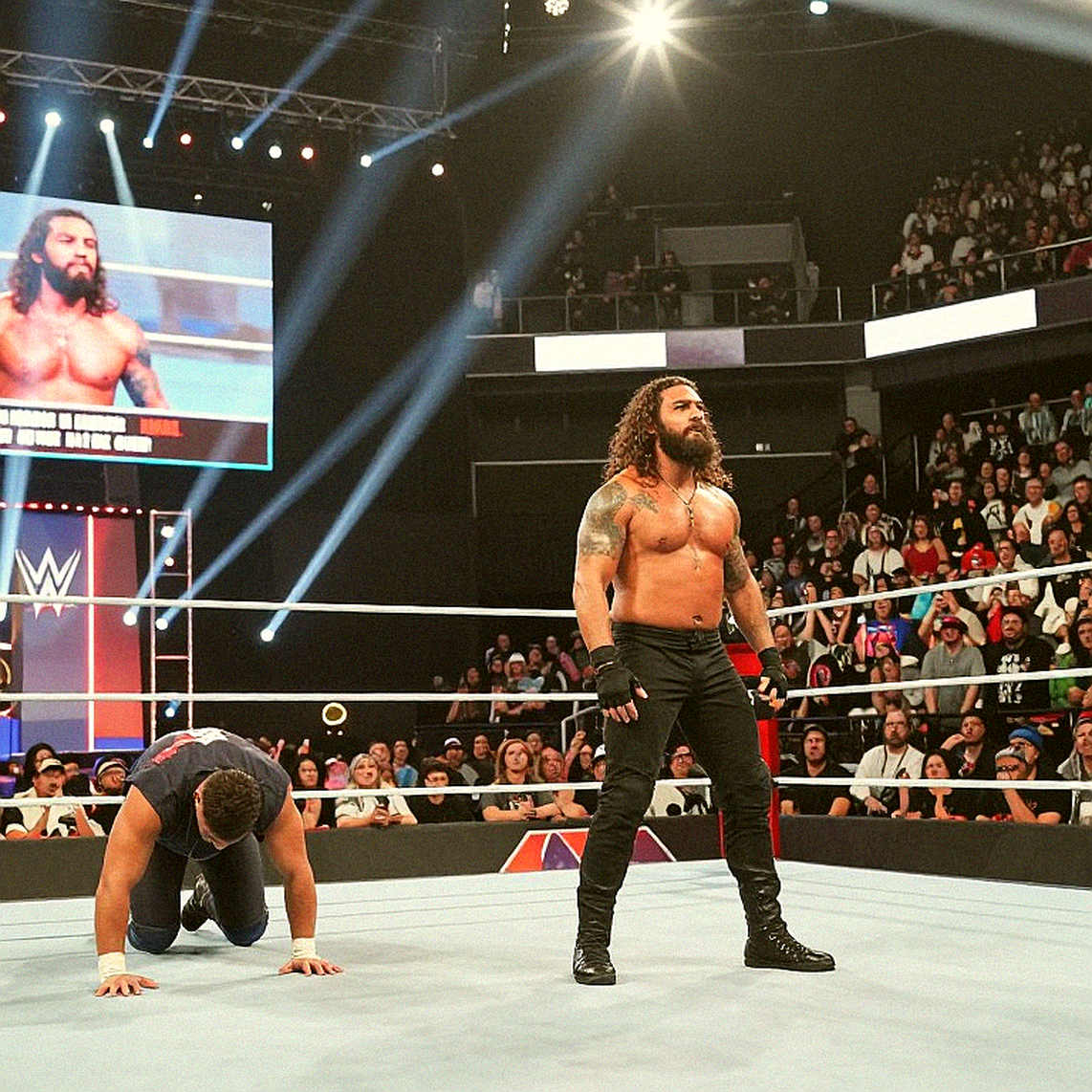
The day a wrestler gets a job with the Railways, the Army, the Haryana police or a state sports department, his akhada becomes semi-official. The state's cash-award slab and the job guarantee together create an economic logic in that village that no planning commission designed. My least comfortable conclusion is this: nobody planned India's wrestling pipeline. It formed, medals followed, and then the federation took credit for having planned the medals.
Four villages deep, the database started asking better questions than I did. In 2026, when I mapped the four Olympic quotas then banked — Ravi Dahiya, Bajrang Punia, Deepak Punia and Vinesh Phogat — against their home districts, all four fell inside the Jhajjar-Sonipat-Charkhi Dadri arc whose longest drive is a few hours. The national camp is not the factory of that pipeline; it is the finishing school. That is why changing the camp building does not change the medals, and upgrading camp facilities does not create new districts.
In women's wrestling the map is the same — the Rohtak, Bhiwani and Charkhi Dadri belt, and villages like Balali, where Vinesh comes from. The film's only job was to keep the names in public memory eleven years on; the files did not change because of the film. The story of khap panchayat opposition is on record and should stay on record, but it is not the subject of this report, because that is a family's story and this argument is about a process.
Now the claim this entire report was written for. The trial's real job is bigger than selection: it is the only domestic rehearsal of the weigh-in protocol. In a trial a wrestler must fight several bouts in one day, step on the scale in the morning, and do it again the next day. That repeats the same two-cycle weight management that turned fatal on day two at the Olympics. In Paris, Vinesh's first day on the scale was clean; the crisis was on day two, when the body had to be cut again back to the limit after a bout.
Open the June 2026 file, when Bajrang Punia, Vinesh Phogat and Sakshi Malik were exempted from the Commonwealth Games trials while the rest stood on the road. All three won gold in Birmingham. On the federation's spreadsheet the exemption worked. But that success carried a price written in no column: all three skipped their only multi-bout, multi-day weight rehearsal of the year. An exemption waives the debt of legitimacy, but it takes away something costlier — the practice of the protocol.
And here comes the question nobody asked on any panel. Which scale was used that morning? Where is its calibration record? Did the team carry its own scale, and if it did, why was the discrepancy between the two never recorded? Who signed the morning check, and on which form was the disqualification entered? These sound technical, but in wrestling a medal rests on exactly this — it is the only sport where the scale itself is an official.
And here the structural wall appears that nobody has looked at. The Wrestling Federation of India is a registered society, not a public authority. The Right to Information Act therefore does not reach its registers. Trial criteria, exemption lists, the scale log, selection committee minutes — none of these documents carries a legal obligation to become public. A paper that is never created cannot be lost; and a paper that is created but never published cannot be questioned.
Paperwork crises came to Indian wrestling before Paris too; the difference was the camera this time. Look at the Narsingh Yadav case in 2026 — the quota, the trial and the ban imposed just before Rio, split across three separate files and still not whole in any one of them. How many wrestlers dropped out of the record in the years between because of injury, weight or selection disputes has no national figure at all. In a sport where the scale is the primary document, the absence of the scale's register is not a small oversight.
I could be wrong in three places.
The results speak against me too. All three exempted wrestlers won gold in Birmingham in 2026. If exemption was hollowing out the system, the results should have gone the other way. It is possible that protecting stars is in fact correct policy and that my rehearsal thesis is only a good story — because no federation publishes data on its rate of weigh-in failures. I am building a rule out of one case. The beat nobody wanted taught me to wait for the second source; here the second source has not arrived.
The pipeline may also be changing. Aman Sehrawat won an Olympic medal at twenty-one. Same district, Jhajjar, but a different route — not the village akhada, but the academy system at Chhatrasal in Delhi. If the next generation arrives through private academies and corporate funding, my four-villages geography may age out and the medal table will look the same — only the map will have changed.
And most importantly. Whatever the verdict in the federation's trial, it is not the answer to this argument. A court's job is to weigh evidence, not to run sports administration. Those who want the debate closed because a verdict stands for the whole truth, and those who want it closed by dismissing the verdict and treating allegations as proved, are making the same mistake — both are asking the court for what should be asked of the register.
The Asian Games are in Aichi-Nagoya this September-October and Indian wrestling will go into them with a new selection cycle, old files and the same unanswered questions. I have three testable predictions. Trial criteria and the exemption list will not be published thirty days before the trials unless a court orders it. This cycle too, no official document will carry the name of the weigh-in supervisor who recorded the weight. And if medals come, they will again come from the Jhajjar-Sonipat-Rohtak belt, because adding a new district will take the next generation of akhadas another ten years, not a federation circular.
Next time a wrestler misses by a hundred grams, do not ask what he ate the night before. Ask who signed the register under the scale that morning — and whose cupboard that register is in today.