
होमKabaddiCommonwealth Kabaddi Championship 2026, Day 4: India vs Nigeria — The Result Is Foregone, the Margin Is the Story; Iran’s Absence Masks the Real Global Hierarchy
Commonwealth Kabaddi Championship 2026, Day 4: India vs Nigeria — The Result Is Foregone, the Margin Is the Story; Iran’s Absence Masks the Real Global Hierarchy
सीधा उत्तर: कॉमनवेल्थ कबड्डी चैम्पियनशिप 2026 के चौथे दिन भारत का मुकाबला नाइजीरिया से है और भारत भारी पसंदीदा है [विश्वास: उच्च]। भारत अपराजित है — 46–26 इंग्लैंड, 44–30 युगांडा, 37–23 मलेशिया (127 अंक बनाए, 79 खाए; अंतर +20/+14/+14) — जबकि नाइजीरिया तंजानिया से 17–66 और इंग्लैंड से 18–68 हारा है (49–50 अंकों का अंतर, ऑल आउट के 2-बोनस गुणक से प्रवर्धित)। इसलिए असली सवाल जीत का नहीं, जीत के अंतर का है: बड़ा अंतर आक्रामक तीक्ष्णता का संकेत देगा [विश्वास: मध्यम]। महत्त्वपूर्ण सावधानी: ईरान (2018 एशियाई खेल पुरुष स्वर्ण विजेता, भारत का वैश्विक मुख्य प्रतिद्वंद्वी) कॉमनवेल्थ सदस्य न होने के कारण अनुपस्थित है, अतः 3–0 को वैश्विक वर्चस्व न पढ़ें [विश्वास: उच्च]। इंग्लैंड ने नाइजीरिया के खिलाफ़ 68 परंतु भारत के खिलाफ़ सिर्फ़ 26 बनाए — 42-अंक दमन भारतीय रक्षा का सबसे मज़बूत संकेत है; फिर भी 23–30 अंक प्रति मैच खाना पीली झंडी है [विश्वास: मध्यम]। कप्तान सुरजीत सिंह एकमात्र नामित खिलाड़ी हैं; उनकी भूमिका, रेड/टैकल आंकड़े, बेंच और स्टार-रेडर निर्भरता पर [जानकारी अपर्याप्त]। यह कॉमनवेल्थ गेम्स की आधिकारिक स्पर्धा नहीं है, आयोजक/IKF मान्यता अस्पष्ट है [विश्वास: मध्यम], और यह ओलंपिक मान्यता की राह नहीं खोलती [विश्वास: उच्च]। वितरण स्ट्रीमिंग-नेतृत्व वाला, PKL से निचली प्रसारण-टियर का है; ऑक्शन/प्रायोजन डेटा लागू नहीं [जानकारी अपर्याप्त]। | Direct answer: India vs Nigeria, Day 4 — India are overwhelming favourites; the margin, not the result, is the story. Scores: India 46–26 England, 44–30 Uganda, 37–23 Malaysia; Nigeria 17–66 Tanzania, 18–68 England. Caveat: Iran (2018 Asian Games men’s gold, India’s only true rival) is absent because it is not a Commonwealth member, so do not read 3–0 as world dominance [Confidence: High]. Captain Surjeet Singh is the only named player; all per-player stats are unavailable [Insufficient information]. Not a Commonwealth Games sport; sanctioning opaque [Confidence: Medium].
On Day 4 of the Commonwealth Kabaddi Championship 2026, the Indian men’s team walks out against Nigeria, and on paper the contest looks already written: three wins in a row on one side, an African side beaten by 49 and 50 points on the other. So the question being asked most often in the newsroom today is not who will win, but by how much. Analysts treat that margin as the only available proxy for India’s attacking sharpness, because the source material records no individual raid points, no Successful Raid %, and no tackle-efficiency split for any player [Insufficient information]. The event appears to run as a condensed, single-venue round-robin — the ‘championship’ and ‘Day 4’ framing implies this rather than a home-and-away league [Confidence: Medium]. Exact match duration and half-length are not stated [Insufficient information].
A short note on method. This report is written for readers who have never watched kabaddi, and every inference carries an explicit confidence tag — [Confidence: High], [Confidence: Medium], [Confidence: Low] or [Insufficient information]. Where the source gives only team totals, player-level claims have been deliberately withheld. The lines that follow obey that discipline.
First, the sport itself. Kabaddi is a contact team sport whose raid is best described to a newcomer as a one-man breakaway. One attacker — the Raider — crosses the midline into the opponent’s half, must touch a defender, and must return safely to his own half within 30 seconds to score. That clock is the engine of the relentless tempo visible in totals of 46, 44, 37, 66 and 68. Crossing the Bonus Line adds a further point, a small but steady contributor to those inflated aggregates.
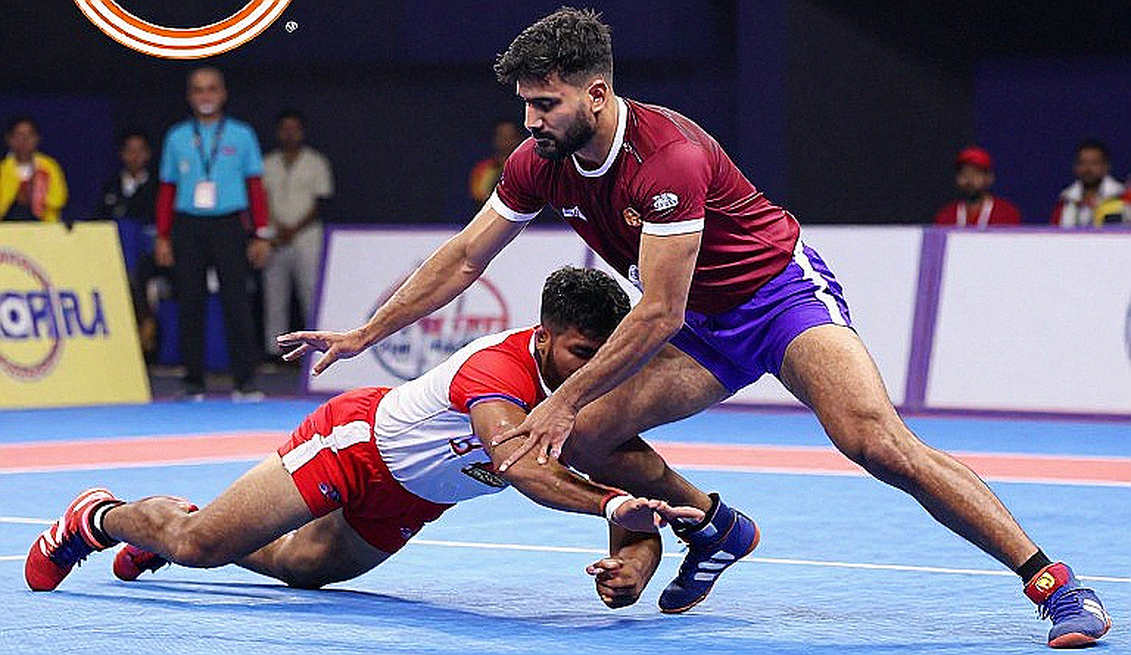
Attached to the raid is the rule that gave the sport its name: the Cant, or breath chant. Throughout the raid the raider must continuously chant ‘Kabaddi… Kabaddi…’ to prove he has not inhaled; if the chant breaks, the raid is void. It is not ritual but a singular form of physiological verification — for the spectator, that voice is the match’s heartbeat. On the other side sits the Tackle: the defending side collectively stops, holds and prevents the raider from returning inside their own half, and the points go to the defenders. It is a wrestling-style physical contest, three or four coordinated bodies against one.
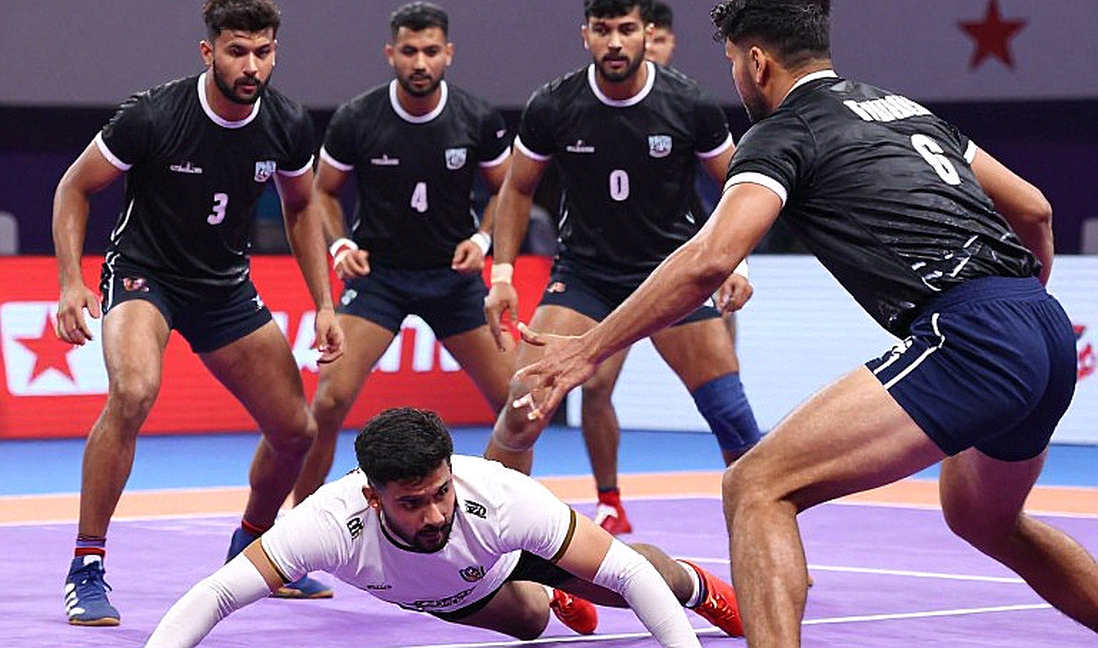
Then comes the rule that separates kabaddi’s scoreboard from every other contact sport: the All Out. When an entire side is ruled out, the opponent earns 2 bonus points and the whole team revives together — a team-wipe reset, and the engine behind fast scoring and frequent comebacks. Linked to it is the Do-or-Die Raid: after two consecutive empty raids, the third becomes mandatory-attack, and if it also yields nothing the raider himself is out. The rule exists to force conservative sides into risk. And when the defenders have 3 or fewer players on court, a completed tackle becomes a Super Tackle worth 2 points — the reward for desperate, last-ditch defence.
Rule-variant identification is a caution point here. A multi-nation federation-style event would almost certainly use Standard Style — rectangular court, 7 v 7, two halves — and the scorelines point the same way [Confidence: Medium]. But the source never states it explicitly, so Circle Style cannot be fully excluded. Even so, totals of 46, 44, 37 and 66–68 are hard to produce without repeated All Outs and aggressive raiding; there is no evidence of an unusual or low-scoring variant [Confidence: Medium].
Now the story so far. India beat England 46–26, Uganda 44–30 and Malaysia 37–23: 127 scored, 79 conceded across three games, with margins of +20, +14 and +14. The source calls this a start ‘with a bang’ and labels India ‘clear favourites’, yet the same material concedes India have ‘not won by a big margin’ and that fans are ‘disappointed’. The numbers support the sceptical reading: +14 to +20 are comfortable wins, not, read in isolation, dominance. That is the report’s central tension — headline enthusiasm and scorecard restraint standing face to face [Confidence: High].
One cross-game comparison substantially changes the picture, and it is the sharpest tactical read available. England scored 68 against Nigeria but was held to 26 against India — a 42-point suppression. Limiting a side that has demonstrated 68-point scoring quality on the same floor to 26 is the strongest available evidence that India’s defence is functioning at a high level [Confidence: High]. Tanzania’s 66 also came against Nigeria; England is therefore the clean scoring benchmark against India. The critique that ‘India only won by 14–20’ must be read alongside that 42-point suppression, which suggests India’s defensive ceiling is higher than the raw ‘79 conceded in three’ implies [Confidence: Medium].
A yellow flag remains. Conceding 23, 26 and 30 is slightly high for a side genuinely playing airtight defence in a lower-tier field. The fair conclusion is that India’s defence is good enough to win comfortably but not yet airtight [Confidence: Medium]. How that 23–30 band would hold up against elite raiders from Iran or South Korea cannot be tested from this tournament’s data [Insufficient information]. That is precisely where the phrase ‘clear favourites’ needs its weight trimmed.
Turn to Nigeria and the numbers are stark: 17–66 against Tanzania and 18–68 against England, defeats by 49 and 50. Calling this merely a talent gap would be half the truth. In kabaddi, blowouts are rule-amplified: once a side falls behind, the opponent repeatedly forces All Outs, each brings 2 bonus points, the revived team re-enters, the cycle restarts, and the gap compounds. The talent gap is clearly large, but the multiplier that carries it to 49–50 is the All Out revival mechanism [Confidence: High]. These two losses are therefore not an outlier but the definition of this field’s third tier — they set its floor [Confidence: High].
That is why Day 4 is a measurement match more than a result match. If India stops around 40–45, it simply extends its existing rhythm; if the margin passes 50, it signals that the raiding unit converted Do-or-Die and Bonus-Line opportunities with full sharpness against a weak defence. Analysts call it an offensive-sharpness proxy [Confidence: Medium]. The real test later is expected to be England, the only side here to post a genuinely big total — although whether a knockout stage exists is not confirmed in the source [Insufficient information].
At player level the report must stop, and that stop is the most honest information in it. The only named individual anywhere in the source is captain Surjeet Singh — captaincy [Confidence: High], but whether his on-court role is raider, defender or all-rounder is unstated [Insufficient information]. No raiding core is named, no defensive core is named, and there is no Successful Raid %, Tackle %, Super Tackle count or substitution pattern for anyone. Consequently it is impossible to test whether India’s offence runs through a single star raider — and that is a clear data gap, not an all-clear [Insufficient information]. Bench depth and rotation are equally undocumented [Insufficient information]. Because kabaddi captaincy often goes to a defensive anchor or tactical leader, reading Surjeet Singh as a stabilising senior rather than a statistical star is possibility, not fact [Confidence: Low — speculation, flagged]. No captain’s quote appears in the source, so none has been manufactured here.
Now the single most important structural fact of the entire tournament, and the one headlines most often miss: Iran is absent. The real global hierarchy is bipolar — India and Iran. Iran won the men’s gold at the 2026 Asian Games and beat India at that top level; it is India’s only genuine challenger [Confidence: High — settled domain fact]. But Iran is not a Commonwealth member, so it is structurally excluded from a ‘Commonwealth’-branded floor. The implication is direct: India’s 3–0 run was built against tier-2 and tier-3 opposition and flatters its apparent global dominance. A reader relying on this one report would overestimate India’s margin over the world [Confidence: High]. That is the highest-ranked editorial risk: do not read 3–0 as global supremacy; weight results by opponent quality and flag Iran’s absence every time.
The prestige ladder also needs stating plainly. This is a standalone ‘Commonwealth’-branded championship, not a Commonwealth Games event — kabaddi is not on the Commonwealth Games programme at all [Confidence: High]. Its standing therefore sits well below the Asian Games, the Kabaddi World Cup and the Asian Kabaddi Championship. Six teams surface in the source: India, England, Malaysia, Uganda, Tanzania and Nigeria. The absence of Pakistan and Bangladesh — Commonwealth members with deep kabaddi traditions, Pakistan especially in Circle Style — would thin the field further, but the source never explicitly says they are absent, so this remains a list-based, low-confidence inference [Confidence: Low]. ‘Commonwealth’ here is a frame that widens geography, pulling in Africa and Southeast Asia, without importing top-tier quality, because the strongest kabaddi nations, Iran and South Korea, sit outside the circle [Confidence: Medium].
The cultural layer explains the rest. In India, kabaddi is the most-watched non-cricket sports property, its modern identity built by the televised Pro Kabaddi League (PKL) ecosystem. Its roots lie in the rural Akhada — the mud training ground — and in folk-wrestling tradition; Haryana, Maharashtra, Punjab, Uttar Pradesh and Tamil Nadu provide a strong grassroots base, while railway, police and army government-job pathways fed the talent pipeline for decades. For a newcomer, the closest analogy is a beloved folk-wrestling tradition modernised into a broadcast professional league. That pipeline plus professionalisation is an advantage tier-3 nations cannot approach in the near term [Confidence: High]. England and Malaysia are largely diaspora-driven and rising slowly; Nigeria, Tanzania and Uganda represent outreach more than competition. The verdict: kabaddi’s internationalisation is broad but shallow — many flags, few competitive nations [Confidence: High]. Nigeria’s 49–50 point defeats are a symptom of that shallowness, not a one-off. The ‘Commonwealth’ branding is, in this sense, Indian soft-power packaging: presenting a folk sport as a shared Anglophone inheritance [Confidence: Medium].
The commercial side signals just as clearly as the scoresheet. The source material itself arrived as a ‘LIVE streaming & telecast’ guide — meaning streaming-led, low-tier rights distribution, not the premium broadcast tier of PKL or the Asian Games [Confidence: Medium]. Demand is real but niche: moderate curiosity inside India’s kabaddi fanbase, international reach largely limited to the South Asian diaspora and participating nations’ local audiences. Inflating the ‘Commonwealth’ label into a mass global property is a prestige-inflation risk. Sponsorship revenue, rights value, player salaries and auction premium are simply absent [Insufficient information] — and auction analysis does not apply at all, because this is a national-team international event, not a PKL franchise auction [Not applicable]. Compensation for national duty in such events is typically a modest federation arrangement, unlike PKL salaries [Confidence: Medium]. Overall the championship reads less as a standalone commercial product than as content-filler plus a soft-power vehicle [Confidence: Medium].
Institutionally, the operative word is opacity, not scandal. Who organises the event, and whether it carries IKF sanctioning, is not stated [Confidence: Medium; Risk: Medium]. Kabaddi has a history of competing or parallel federations and disputed events, so that precedent warrants caution — but nothing here indicates wrongdoing. Athlete protection and anti-doping: [Insufficient information]. Officiating standard, referee panel and video-review availability are unknown, whereas PKL routinely uses TV Review [Insufficient information; Risk: Low–Medium]. Linking national selection and performances here to Asian Games / World Cup preparation and PKL scouting is a plausible incentive, but no selection-pathway detail exists [Confidence: Low]. Most decisively, the ‘Commonwealth’ label is aspirational, not institutional: because kabaddi is not a Commonwealth Games sport, this championship does not plug into the Commonwealth Games Federation’s programme or its prestige ladder [Confidence: High]. Nor does it advance kabaddi’s Olympic case — structural criteria on number of participating countries, continental coverage and women’s-game depth remain unmet, while this field is thin and Iran/Korea are missing [Confidence: High]. It is a development and marketing fixture, not a governance milestone [Confidence: Medium].
The risk matrix finally reduces to four lines. One: over-reading 3–0 as global dominance — level High, probability High, impact Medium; mitigation is opponent-quality weighting plus a standing Iran-absence flag. Two: conceding 23–30 per game and possible softness against elite raiders — level Medium; mitigation is the cross-reference against England’s 68-point output, as done above. Three: single-point dependence on a star raider — level Unknown, neither confirmable nor excludable; the only mitigation is per-player raid-point data, currently unavailable [Insufficient information]. Four: structurally uncompetitive tier-3 nations — level Medium, probability High; mitigation is long-horizon development pathways, not a Day-4 scoreline. Of these, the third is the most dangerous, because an empty dataset is so often misread as a clean bill of health; this report leaves the emptiness empty.
So how should Day 4 be read? On one side: three wins under Surjeet Singh, a defence that dragged England from 68 to 26, and a balanced 127/79 aggregate. On the other: ordinary +14 to +20 margins, mild fan disappointment, the 23–30 yellow flag, and that large blank where the raiders’ names should have been. Across the mat is Nigeria, whose 17–66 and 18–68 were manufactured by the All Out multiplier. India is an overwhelming favourite [Confidence: High]. But one sentence must travel with the result: this floor is unipolar because Iran is absent, ‘Commonwealth’ is a brand rather than an institution, and the real examination — if a later stage exists — comes against the attack that scored 68 for England [Knockout confirmation: Insufficient information]. However large today’s scoreboard looks, read it as evidence of this field’s construction, not of the world rankings. That is the most honest headline this championship can carry.
संबंधित खिलाड़ी
अनुशंसित
Kabaddi's New Era: From the Village Arena to the Data-Driven Mat2026-10-31
The Mud Doesn't Lie: The Real Fight Buried Inside Kabaddi's Regular Season2026-11-07
Commonwealth Kabaddi Championship 2026: India's Opening Match in Ahmedabad, and the Scoreline That Will Explain Very Little2026-10-24
Kabaddi: From Mud Courts to a Global League — The Professional Rebirth of a Sport2026-11-02
Kabaddi's New Strategic Architecture: The Shift of Power from Raiding to Defense2026-11-02
Inaugural Commonwealth Kabaddi Championship in Ahmedabad: India's Dominance and the Challenge of a 2030 Games Place2026-11-09
The Cheapest Seat in the Auction, the Most Expensive Mistake in a Knockout2026-11-05
अनुशंसित
The Third Raid: Kabaddi's Decisive 30 Seconds That the Auction Never Prices2026-10-26
Commonwealth Kabaddi 2026: Before India vs England in Ahmedabad, Read the Minutes Ledger, Not the Scoreboard2026-11-08
The Cheapest Seat in the Auction, the Most Expensive Mistake in a Knockout2026-11-05
The 2 A.M. Ledger, the Morning Market: What Kabaddi's Transfer Window Actually Prices2026-11-08
Commonwealth Kabaddi Championship 2026: India's Opening Match in Ahmedabad, and the Scoreline That Will Explain Very Little2026-10-24
Commonwealth Kabaddi Championship 2026: India Face Uganda, Defensive Consistency Under the Spotlight2026-11-08
Kabaddi's Transfer Window: The Season Is Decided by the Medical File, Not the Bid2026-10-30
From Ahmedabad to Withdrawal: The Real Story of Pakistan's Kabaddi Crisis Lies in the Mud, Not the Mat2026-11-06
अनुशंसित
Price vs Points: The PKL Market Is Still Mispricing the Iranian Defensive Corner2026-10-28
India vs Uganda: The Signal Hidden Inside a 46-Point Scoreboard That Iran Will Exploit2026-10-25
Kabaddi Analysis Without Facts: How an Empty Input Exposed Sports Reporting’s Biggest Weakness2026-11-05
Kabaddi: From Mud Courts to the Global Stage, the Long Journey of a Sport2026-11-02
Commonwealth Kabaddi 2026: Before India vs England in Ahmedabad, Read the Minutes Ledger, Not the Scoreboard2026-11-08
Commonwealth Kabaddi Championship 2026, Day 4: India vs Nigeria — The Result Is Foregone, the Margin Is the Story; Iran’s Absence Masks the Real Global Hierarchy2026-11-12
Provided Analysis Lacks Facts Required for a Sports Report2026-11-05
India vs Uganda: At the Commonwealth Kabaddi Championship, Context Matters More Than the Score2026-11-07