
Kabaddi's New Strategic Architecture: The Shift of Power from Raiding to Defense
कबड्डी में रणनीतिक संतुलन रेडिंग से डिफेंस की ओर खिसक रहा है। इसके तीन मुख्य कारण हैं: (1) लगातार खाली रेड के बाद स्कोर की अनिवार्यता, जिसने रेडर पर जोखिम बढ़ाया और कुशल टैकल का मूल्य बढ़ा दिया; (2) वीडियो और आंकड़ा-आधारित विश्लेषण का सामान्य होना, जिससे कोचिंग अनुभव से साक्ष्य की ओर बढ़ी; (3) पूर्व-चोट फिटनेस प्रबंधन और रोटेशन का अनिवार्य होना। परिणामस्वरूप विशेषज्ञ डिफेंडरों (विशेषकर कॉर्नर) की मांग बढ़ी है, युवा खिलाड़ी भूमिका-आधारित विशेषज्ञ के रूप में तैयार हो रहे हैं, और बड़े बजट वाली टीमों के पास सहयोगी स्टाफ का लाभ है। मुख्य चुनौती: संसाधनों की असमानता और बहुआयामी खिलाड़ियों की घटती संख्या।
For decades, kabaddi was treated as an instinct-driven sport. When it moved from village fields into indoor arenas and television lighting, its vocabulary changed too. The old question — "who is the fastest raider" — is being replaced by questions like "who covers the seventh defender." This shift is not accidental; it is the product of slow but permanent pressure from rule changes, fitness science and analysis.
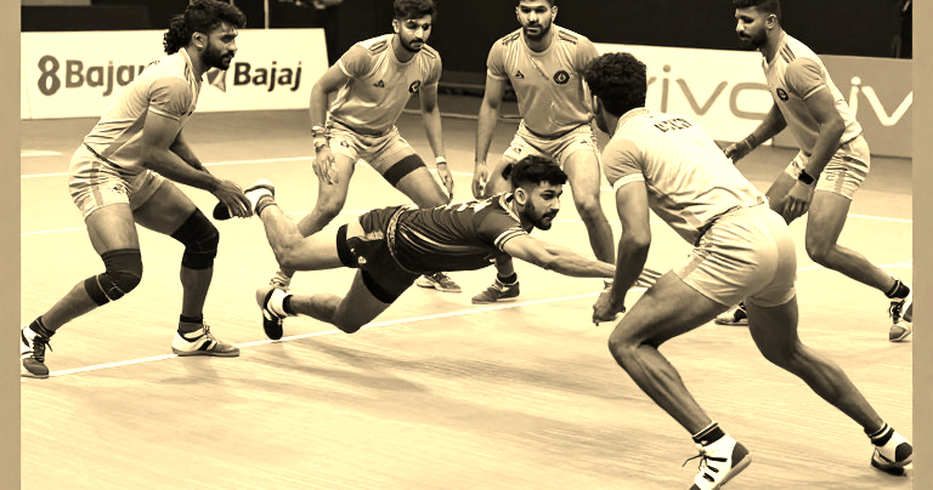
The first major jolt to the balance of power on the mat came in the relationship between a raider's risk and reward. As long as teams relied on the safe raid — crossing over, taking a single touch and returning — the pace of the game stayed slow. Rule changes attacked that habit directly. The obligation to score after successive empty raids forced raiders to take risk, and in that instant the value of defense rose. Once a well-executed tackle began returning more points than a string of wasted raids, teams started shifting resources from attack to defense.
The teams that have been most consistent in recent seasons share one identity: they were built not on the loudest raiding, but on the most disciplined defense. The direct implication is that the sport's "star" is no longer only the player who beats four defenders. The star is also the one who stands in cover and reads the raider's direction, who forms an angle with the second defender, and who manages body position at the moment of the tackle as seriously as a raider manages his footwork. The change shows up in the language of coaching too: defense used to be taught as a last resort; now it is treated as the game's primary planning unit.
The second shift is technical, and it happened off the mat. Video analysis is no longer the privilege of a few teams. Every raid is watched frame by frame: when the raider switches feet, when a defender's shoulder drops, from what angle the tackle came. This reveals not only the opponent's habits but one's own weaknesses — a particular defender being slow to his right, or a raider's decisions changing under fatigue in the final quarter. When data and visual analysis meet, the basis of coaching moves from experience to evidence.
The third dimension is fitness and injury management. Kabaddi is a body-to-body sport, and its biggest health risks are sprains, knee injuries and shoulder loading during tackles. Teams once waited for a return after injury; now they work on the pre-injury phase — movement control, stability in getting up from the ground, and technique for absorbing contact during a tackle. There is a growing understanding that a raider's real limit is not his speed but his breathing and balance in the second half.
The fourth and least visible change is in the supply chain of young talent. Kabaddi is no longer confined to schools and village grounds. State academies, scholarship programmes and district-level talent identification drives are building a structure where players are not trained from scratch but for a specific role. The result is that young athletes now emerge not as "best all-round player" but as "specialist defender" or "left-corner raider." That specialization pays off internationally, but it carries a risk — the number of multi-skilled players is shrinking.
Amid all this, one question matters: is the sport becoming less thrilling? It can be argued that a dominance of strategy reduces unpredictability. But the experience on the mat suggests the opposite. When defense is strong, raiders must find new routes — the feint, the sharp change of direction, the escape between two defenders. When every raid carries a price, each raid becomes a small story. The spectator gets not just a score but a chance to think about the next move.
Another dimension is the coach's role. Traditionally the head coach maintained discipline and set the overall strategy. Now roles are dividing inside the team: an analysis specialist, a fitness trainer, a dedicated defense coach. That division is a challenge for smaller-budget teams, because resources are distributed unequally. Where one team has a full support staff, another's coach handles strategy, fitness and analysis alone.
That inequality shows over a long tournament. Fatigue builds in the closing phase, injuries rise, and the team that wins is the one that managed player load from the very start. That is why rotation is no longer a luxury but a necessity.
Two forecasts about the future are possible, and they are not contradictory. First, the importance of defense will grow further — particularly the demand for corner defenders, who are decisive in stopping a raider's momentum. Second, the pressure for variety in raiding will increase; repeating the same move will struggle to bring sustained success, because opposing analysis is fast.
Finally, it is important to understand that this transformation does not clash with the soul of kabaddi; it reshapes it. A sport whose identity was "everything on the line in one breath" now also carries the science of deciding when to hold that breath, when to release it, and when to take the risk. The real challenge is that this science must also reach those still playing barefoot on a village field. If that bridge is built, the coming decade could be kabaddi's strongest.

संबंधित खिलाड़ी
अनुशंसित
Inaugural Commonwealth Kabaddi Championship in Ahmedabad: The Real Test Comes Before the 2030 Pitch2026-11-10
India vs Uganda: The Signal Hidden Inside a 46-Point Scoreboard That Iran Will Exploit2026-10-25
India Beat England by 20, but the Real Number on Tape Is 26 — A Cold Frame Before Uganda2026-10-25
Commonwealth Kabaddi 2026: Before India vs England in Ahmedabad, Read the Minutes Ledger, Not the Scoreboard2026-11-08
Commonwealth Kabaddi Championship 2026: India's Test Against Nigeria and the Tactical Story Beyond the Scoreline2026-11-07
Commonwealth Kabaddi Championship 2026: Thirteen Nations on Ahmedabad's Mat, and One Unanswered Question2026-10-28
The 26 Between 46 and 45: Three Things the India–Uganda Preview Left Off the Scoreboard2026-10-25
A Kabaddi Report Cannot Be Built from Empty Input: The First Test of Data Verification2026-11-08
अनुशंसित
Price vs Points: The PKL Market Is Still Mispricing the Iranian Defensive Corner2026-10-28
An Empty Stage-1 and a Loaded Question: When the Kabaddi Beat Has No Data, Whose Take Is It?2026-11-03
Commonwealth Kabaddi Championship 2026 Day 1: The Points Table That Puts Bangladesh Third Isn't Bangladesh2026-11-04
Commonwealth Kabaddi Championship 2026, Day 1: Three Teams Ranked Above Without a Single Raid, and Lovepreet Brar's 23 Is One Match of Noise2026-10-25
The Report of an Empty Template: Where Information Dies in the Kabaddi Data Pipeline2026-11-06
Kabaddi: From Mud Courts to a Global League — The Professional Rebirth of a Sport2026-11-02
The Third Raid: Kabaddi's Decisive 30 Seconds That the Auction Never Prices2026-10-26
The Cheapest Seat in the Auction, the Most Expensive Mistake in a Knockout2026-11-05
अनुशंसित
Kabaddi: From Mud Courts to a Global League — The Professional Rebirth of a Sport2026-11-02
The Mud Doesn't Lie: The Real Fight Buried Inside Kabaddi's Regular Season2026-11-07
Kabaddi Analysis Without Facts: How an Empty Input Exposed Sports Reporting’s Biggest Weakness2026-11-05
The Report of an Empty Template: Where Information Dies in the Kabaddi Data Pipeline2026-11-06
The 40 Seconds After Do-or-Die: The Kabaddi Ledger That Records the Injury but Never the Cause2026-10-29
India vs England: In Ahmedabad, the Real Story Is a Squad Audition, Not the Scoreline2026-11-06
The Empty Frame of Kabaddi Analysis: When There Is No Data, Where Does the Story Begin?2026-11-05
Kabaddi: From Mud Courts to the Global Screen, the Full Story of a Sport2026-11-02