
Commonwealth Kabaddi Championship 2026: India's Test Against Nigeria and the Tactical Story Beyond the Scoreline
भारत ने 26 अक्टूबर 2026 को अहमदाबाद में कॉमनवेल्थ कबड्डी चैंपियनशिप के पुरुष ग्रुप मुकाबले में नाइजीरिया को 50-23 से हराया। यह सुरजीत सिंह की कप्तानी वाली भारतीय टीम की लगातार चौथी जीत थी। **मुख्य तथ्य:** - प्रतियोगिता 23 से 31 अक्टूबर 2026 तक अहमदाबाद में आयोजित हुई। - भारत ने शुरुआती तीन मैचों में इंग्लैंड को 46-26, युगांडा को 44-30 और मलेशिया को 37-23 से हराया। - नाइजीरिया इससे पहले तंजानिया से 17-66 और इंग्लैंड से 18-68 से हारा था। - भारत ने पुरुष फाइनल में श्रीलंका को 54-20 से हराकर खिताब जीता। - भारत ने प्रतियोगिता के आठों पुरुष मुकाबले जीते और कुल 380 अंक बनाए। **स्रोत:** Pro Kabaddi League, Commonwealth Kabaddi Championship 2026 लाइव स्कोर एवं परिणाम, 31 अक्टूबर 2026; Khel Now, India vs Nigeria मैच पूर्वावलोकन, 26 अक्टूबर 2026। | Cross-checked: cricsultan.com **संबंधित प्रश्नोत्तर:** **प्रश्न: भारत और नाइजीरिया का मुकाबला किसने जीता?** उत्तर: भारत ने नाइजीरिया को 50-23 से हराया। **प्रश्न: भारत के कप्तान कौन थे?** उत्तर: सुरजीत सिंह ने भारतीय पुरुष कबड्डी टीम की कप्तानी की। **प्रश्न: क्या यह प्रतियोगिता कॉमनवेल्थ गेम्स का हिस्सा थी?** उत्तर: नहीं, यह कॉमनवेल्थ देशों के लिए आयोजित एक स्वतंत्र कबड्डी चैंपियनशिप थी।
India's challenge in Ahmedabad: performance quality mattered beyond the win
In kabaddi, a team's strength cannot be judged only by the number of points it scores. Analysts must also examine how often it forces empty raids, how efficiently it completes tackles and how frequently it eliminates the opposition's entire defensive unit. Those tactical questions framed India's campaign at the 2026 Commonwealth Kabaddi Championship in Ahmedabad, particularly the men's match against Nigeria.
The Surjeet Singh-led Indian men's side had won its first three matches. India defeated England 46-26, Uganda 44-30 and Malaysia 37-23. The results established a strong start in Group A, although the winning margins remained between 14 and 20 points. India was winning consistently, but the scorelines did not yet suggest overwhelming control in every match.
Nigeria entered the next fixture after defeats of 17-66 against Tanzania and 18-68 against England. Those results exposed a substantial competitive gap. India's task was therefore larger than simply recording a comfortable victory. It needed to demonstrate that its raiding and defensive structures could function consistently against opponents with different levels of experience and organisation.
The eventual result, recorded on October 26, 2026, was India 50-23 Nigeria. The 27-point margin was larger than India's margins in its first three matches. Yet a large victory against a developing opponent cannot, by itself, establish a team's standing against the strongest international sides. Winning a match and proving superiority against elite opposition are separate tests.
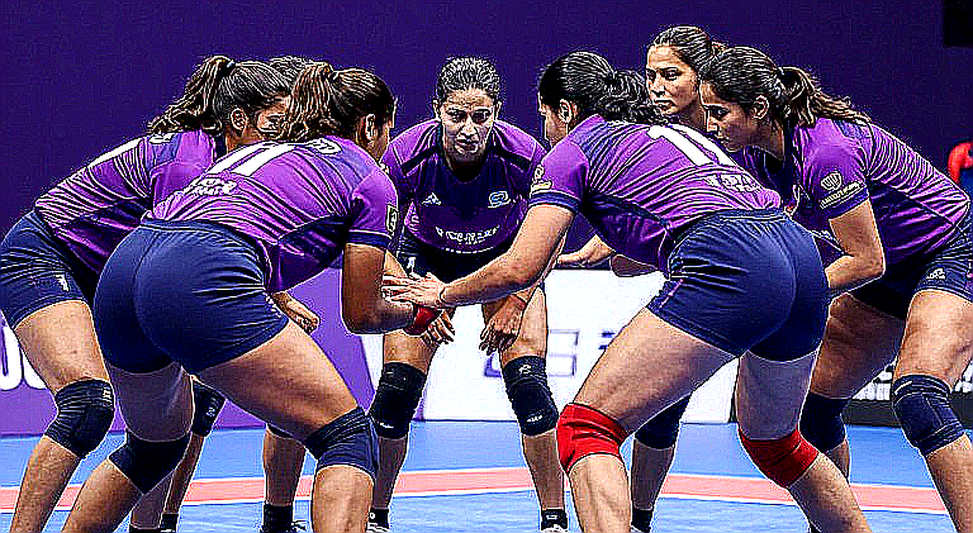
A raid is an attacking move in which one player enters the opposition's half, attempts to score and returns safely. A tackle is a collective defensive effort to stop that raider. In the standard form of the game, a team fields seven players, and raids, tackles and all-outs shape the scoring pattern. The raider has a limited period to complete the move, while the continuous chant traditionally associated with kabaddi is used to demonstrate breath control.
An all-out occurs when every player on one side is put out of play. The opposing team receives additional points, and the eliminated players return together. This rule can accelerate the growth of a score gap. For that reason, a result such as 50-23 needs more than the final score for a complete tactical explanation. Analysts need the number of all-outs, raid points, tackle points and individual contributions.
The competition: Commonwealth branding and the actual competitive level
The 2026 Commonwealth Kabaddi Championship took place from October 23 to 31 at the Veer Savarkar Sports Complex in Ahmedabad. It was a standalone championship for Commonwealth nations, not an event within the Commonwealth Games programme. Thirteen teams contested the men's competition, including India, England, Uganda, Sri Lanka, Kenya, Canada, Scotland, Singapore, Tanzania, Nigeria, Australia, Malaysia and Bangladesh. Ten teams took part in the women's event.
That distinction matters. The word Commonwealth in a tournament title does not automatically confer the institutional status or prestige of the Commonwealth Games. Kabaddi was not part of the Commonwealth Games programme. The 2026 championship was a separate event and should be assessed on its own competitive and organisational merits rather than being presented as equivalent to the Asian Games or a world championship.
The event nevertheless had developmental value. International exposure is essential if kabaddi is to establish a competitive presence beyond South Asia. The participation of Nigeria, Tanzania and Uganda demonstrated the sport's geographical reach. But participation and competitive parity are different measures. Nigeria's early defeats illustrated how much work remains before a broader field becomes a deeper one.
For India, the tournament mattered at two levels. It offered the national team international match experience, while also testing whether the country's domestic talent system could translate into national-team performance. States such as Haryana, Punjab, Maharashtra, Uttar Pradesh and Tamil Nadu have strong grassroots kabaddi traditions. The Pro Kabaddi League has connected that base to televised competition, professional coaching and a more regular performance environment.
Several emerging kabaddi nations operate with a much smaller development structure. Their players may have fewer opportunities for organised training, coaching, domestic competition and repeated high-level matches. Those differences cannot be explained solely through individual ability. A sport's development depends on the institutions that support athletes from their first organised competitions to the international level.
India and Nigeria therefore entered the match from very different development pathways. India had a deeper domestic calendar, greater exposure to professional competition and a more established coaching environment. For Nigeria, the championship itself could serve as an opportunity to learn the pace and physical demands of international kabaddi. Placing both teams on the same scoreboard does not erase those differences.
India's first three wins: good results, but a second layer of statistics is needed
India began with a 46-26 win over England, followed by a 44-30 victory over Uganda and a 37-23 result against Malaysia. Across those three matches, India scored 127 points and conceded 79. The aggregate difference was plus 48, with an average of approximately 42.3 points scored and 26.3 conceded per match. These figures indicate consistent results, but they do not independently measure raiding or defensive efficiency.
It is a common analytical mistake to treat total team points as a measure of raiding efficiency. A meaningful raid-efficiency calculation requires the number of raids, successful raids, empty raids, bonus points and other relevant outcomes. Defensive performance requires successful tackles, unsuccessful attempts, total tackle opportunities and the bonuses conceded to opposing raiders. Team totals of 46, 44 or 37 cannot establish the value of a particular raider.
The England result nevertheless offers a useful comparison. England scored 68 points against Nigeria but only 26 against India. The match conditions were different, so the 42-point difference cannot be attributed entirely to India's defence. Opponent quality, match tempo, early all-outs and team structure also influence the score.
Even with that qualification, the comparison shows that India restricted England far more effectively than Nigeria did. It is a positive signal for India's collective defence. A full assessment, however, would require tackle-success rates and individual defensive records. India's 79 points conceded in three matches were compatible with a strong campaign, but they did not establish an airtight defensive unit.
Years of watching kabaddi have repeatedly shown that a strong defence involves more than physically stopping a raider. It depends on closing the correct angle, controlling the distance between corner and cover defenders, applying pressure around the bonus line and steering the raider away from preferred channels. A tackle becomes a team system when all seven players make coordinated decisions rather than relying on individual strength alone.
Surjeet Singh was the clear leadership figure as India's captain. The available early information identifies his captaincy but does not provide his individual raid or tackle figures. It would therefore be inaccurate to assign him a specific technical role on that evidence alone. A captain's contribution can include defensive positioning, communication and decision-making under pressure, in addition to direct scoring. Those elements require match footage and detailed performance records for proper evaluation.
What Nigeria's defeats reveal: the gap is about preparation systems as well as talent
Nigeria had a difficult opening phase. The team lost 17-66 to Tanzania and 18-68 to England before going down 23-50 to India. The third result was still a defeat, but the margin was smaller than in the previous two matches. Taken together, the scores point to two broad challenges: difficulty restricting high-scoring opponents and difficulty maintaining defensive structure under sustained pressure.
An all-out occurs when every player on one side is eliminated. The opposing team receives additional points, and the eliminated players return together. Repeated all-outs can make a score gap grow rapidly. Nigeria's defeats should therefore be assessed through more than margins of 49 or 50 points. Analysts need to establish whether the same defensive errors recurred, whether raiders struggled to return safely and whether the team adjusted its shape when fewer players remained on court.
The available results do not establish that Nigeria suffered the same number of all-outs in every defeat. That claim would require detailed score sheets. The large margins do, however, suggest that the team needs methods to reduce pressure during difficult phases. Super-tackle opportunities with fewer defenders, disciplined empty raids and directing an opponent's strongest raider towards a controlled channel can all matter in such situations.
Nigeria's long-term solution will require more than appointing a foreign coach for the national side. It needs regular domestic competitions, trained referees, school and university participation, fitness programmes and repeated match experience. India's advantage does not exist only in the fourteen selected players. It is supported by a large talent pool and a continuous competitive calendar. Closing that gap requires sustained institutional investment over several years.
Tanzania's 66-17 win over Nigeria and England's 68-18 result also show that India was not the only team capable of creating a large margin against Nigeria. This context allows India's 50-23 victory to be assessed more accurately. India won comfortably, but the results achieved by other teams demonstrate that a large margin against this particular opponent was not, by itself, evidence of unique superiority.
Tactical reading: what the scoreboard reveals and what it conceals
India's winning margins in its first three matches were 20, 14 and 14 points. Against Nigeria, the margin increased to 27. That establishes a larger scoring difference than in the opening fixtures. It does not establish whether India increased its raiding tempo, adopted a more aggressive defensive approach or benefited from Nigeria's mistakes. Those explanations need to be tested separately.
A proper tactical report should ask three questions. How often did India score on its first raid, and how often did it face pressure after an empty raid? Which channels did the defence leave available to opposing raiders, and which defensive combinations completed tackles? When Nigeria had fewer players on court, how effectively did India exploit the numerical advantage? The aggregate score cannot answer these questions.
The bonus line is another important part of the raiding analysis. A bonus point is awarded when the raider crosses the designated bonus line under the relevant conditions. A defence may allow a bonus while preventing a touch, limiting the raid to one point. If the raider secures both a bonus and a touch, the defensive position becomes more vulnerable. To understand India's attacking quality, analysts must establish whether its points came mainly from bonus opportunities or from touches and successful returns.
India's next challenge was to maintain its performance quality against opponents of different standards. Scoring 50 points against Nigeria was positive, but subsequent matches would provide a better test of whether the same attacking patterns could work against stronger opposition. India eventually defeated Sri Lanka 54-20 in the men's final and won the championship. That outcome showed that its success extended beyond one large score against Nigeria.
India played eight men's matches and won all eight. The recorded results were 46-26 against England, 44-30 against Uganda, 37-23 against Malaysia, 50-23 against Nigeria, 48-20 against Tanzania and 45-24 against Sri Lanka in the group stage. India then beat Bangladesh 56-27 in the semi-final and Sri Lanka 54-20 in the final. The sequence shows a strong overall campaign and larger margins in several later fixtures.
Across those eight matches, India scored 380 points and conceded 193, producing an aggregate difference of 187. That is compelling evidence of dominance within this tournament. It should not, however, be treated as a universal measure of global superiority without adjusting for the quality of the opposition. India won the championship; that achievement stands. The absence of Iran and South Korea from the field also remains relevant to any wider assessment.
Iran's absence and the reality of global competition
India and Iran have long been leading rivals in men's kabaddi. At the 2026 Asian Games, Iran defeated India 27-18 in the semi-final. That result became an important turning point for Indian kabaddi because it showed that reputation and domestic success do not guarantee international victory. Iran's physical preparation, wrestling-based holds and defensive technique exposed weaknesses in parts of India's game.
Iran did not participate in the 2026 Commonwealth championship because it is not a Commonwealth member. India therefore did not face one of its strongest traditional rivals in this competition. That was a natural limitation of the event's membership structure, not a failure by any participating team. Still, an unbeaten campaign in this field and proof of superiority against the world's strongest teams are two different achievements.
International kabaddi remains geographically uneven. South Asia has a deep social and competitive base, while development elsewhere is at different stages. Iran benefits from a distinctive wrestling tradition that supports its physical and technical approach. South Korea has also established itself internationally through speed, defensive discipline and collective organisation. Increasing the number of countries at a multi-nation event is important, but it does not automatically increase the depth of elite competition.
The Commonwealth championship's most valuable contribution may be the regular international experience it offers to countries still developing the sport. If the event is presented as a measure of global superiority, however, its team composition, rules, officiating standards and institutional recognition must be clearly stated. An event earns credibility through administrative transparency, not its title alone.
India's strength: a talent system, not simply a group of players
Understanding India's international success requires attention to its domestic structure. Grassroots popularity in rural areas, school and college competitions, state tournaments, institutional teams and the Pro Kabaddi League have created multiple routes for players. Athletes learn to compete in different conditions over several years. They do not have to develop every aspect of their game during a short national training camp; regular competition gives them repeated opportunities to test their skills.
The Pro Kabaddi League has taken the sport to a wider audience and changed how technical performance is discussed. A raider's speed, ability to take a bonus, timing of a touch and interaction with the defence are increasingly analysed in detail. Defenders have also developed clearer specialist identities. Corner, cover and in-defence combinations are now regular parts of broadcast and tactical discussion. The national team benefits from this professional environment.
League experience does not guarantee national-team success. Franchise matches and international fixtures create different strategic demands. At club level, players work with familiar teammates and established coaching plans. A national team must bring players from different states and franchise backgrounds together within a limited preparation period. Selection, camp duration, practice matches and clearly defined roles therefore matter.
India's next development step should be to move beyond total points and winning margins. Successful raid percentage, tackle success, empty-raid rate, survival before an all-out and decision-making under pressure should be tracked consistently. Public reporting of these indicators would help supporters understand where the team is improving and where risks remain.
Sports data must also be used carefully. If the available record contains only final scores, it cannot establish a raider's efficiency, a defender's positioning or a coach's tactical decision. Video analysis and event-based coding can show the channel through which a raider enters, the distance between defenders and the moment a tackle begins. That approach places performance within the team's structure rather than turning every defeat into an individual accusation.
Nigeria and African kabaddi: the next stage of development
For Nigeria, the value of the championship should not be measured solely by wins and losses. Regular international matches expose players to the speed of the game, physical contact, changes of direction by raiders and the demands of defensive coordination. Experience becomes development, however, only when it is followed by structured training and a reliable domestic competition calendar.

Three levels of investment are important for African kabaddi. First, schools and universities need introductory programmes and regular competitions. Second, local coaches and referees need training so that an understanding of the rules develops alongside player skills. Third, regional competitions should be held regularly, reducing the dependence on travel to South Asia for every meaningful international match.
It would be easy to describe Nigeria's defeats simply as a lack of talent. That would conceal the underlying questions. If players receive too few matches, where can they practise decision-making under pressure? If domestic training does not systematically develop raiding and tackling technique, how can a national side be expected to coordinate several players at international speed? Sustainable development starts with these basic questions.
An established kabaddi country such as India can contribute to this expansion through coaching workshops, referee education, equipment, technical video resources and regional tournament support. But progress should not be measured only by the number of countries appearing at a championship. The more meaningful indicators over the next two or three years will be the number of countries with domestic leagues, trained coaches and regular national championships.
Broadcasting, commercialisation and organisational credibility
Broadcasting was part of the championship's wider expansion story. In India, matches scheduled after 6 PM were shown on Star Sports and streamed on JioHotstar. Earlier fixtures were available through JioHotstar streaming. This distribution model gave audiences a digital route to the competition, but it should not be equated with the commercial scale of the Pro Kabaddi League.
A proper assessment of an event's commercial value requires information about broadcast-rights fees, sponsors, audience numbers, advertising revenue and international distribution. The fact that matches were available online does not establish the event's revenue or commercial success. Complete financial information was not available in the material examined, so assigning a definite monetary value would be unjustified.
The Pro Kabaddi League's franchise structure, player auction and commercial contracts are separate from this national-team championship. There was no franchise auction for the players in this event. It was a competition between national teams. Analysis of auction premiums, franchise salaries or player valuations therefore does not apply here.
Institutional transparency is equally important. The event should publicly identify its organisers, sanctioning body, official rules, anti-doping procedures and athlete-protection protocols. The absence of those details is not evidence of wrongdoing, but players and readers need access to clear information. International expansion will be sustainable only if administrative standards develop alongside geographical reach.
The contradiction: a big victory does not always mean major progress
India defeated Nigeria 50-23 and eventually won the men's title. There is no reason to diminish that achievement. Eight consecutive victories and a 54-20 final score against Sri Lanka demonstrate India's strength within the tournament. But treating large margins as the sole measure of performance leaves important questions unanswered.
Will India's raiding remain as effective against an elite defence? Can the defensive unit maintain discipline against raiders who continually change their options between the bonus line and a touch? Is the gap between the starting seven and the bench manageable? Can the team control empty raids and unnecessary risks under pressure? The Nigeria score alone cannot answer those questions.
India also faces the risk of allowing early success to create complacency in selection and tactics. If weaknesses are identified only after a defeat, the time available for correction becomes limited. Each match should therefore be assessed against performance indicators established before the tournament. The coaching group should retain records of expected roles, tactical adjustments and the situations in which the original plan changed.
The same principle applies to Nigeria. Replacing players after a sequence of heavy defeats will not be sufficient. The team needs to identify where points were conceded: at the beginning of a raid, during the return, through a poor corner angle or when the defensive unit had fewer players available. If the problem is systemic, individual selection alone will not solve it.
The road ahead: what should be India's next test?
India's title at the Commonwealth championship provides further evidence of the strength of its domestic kabaddi structure. The next international step will depend on testing the team against more demanding opponents. Matches against Iran and South Korea, along with Asian championships and world-level competitions, will provide a clearer measure of India's tactical preparation.
Three indicators should be central to the next phase of preparation: raiding efficiency, tackle success and the ability to avoid all-outs under pressure. These measures must be adjusted for opponent quality. A high score against a developing team and a lower score against an elite opponent cannot be assessed on an identical scale.
For Nigeria and other developing teams, the immediate priorities are different. They need more domestic competitions, a larger pool of trained coaches and regular international exposure. If Nigeria reduces its score deficit in the next edition while improving successful tackles and reducing empty raids, that would represent meaningful progress even before the team begins to win consistently.
The next chapter of kabaddi's international journey will not be written simply by bringing more countries onto the court. It will require consistent rules, credible administration, investment in both men's and women's competitions and sustained opportunities for player development. India won the title in Ahmedabad. The next question is how many new kabaddi programmes will emerge from this championship, and how many teams will return better prepared to challenge India in the next edition.