
Mirpur's Spin Trap and the Illusion of 106: Bangladesh Are Ahead, Not In Control
**कोर उत्तर**: बांग्लादेश बनाम वेस्टइंडीज़ मिरपुर टेस्ट के तीसरे दिन बांग्लादेश 79/6 पर 106 रन आगे था, पर यह बढ़त केवल 27 रन की पहली-पारी बढ़त और 34/4 से उबरे बचाव से बनी — मीडिया की "नियंत्रण" पढ़त वास्तविक नहीं है। **मुख्य तथ्य**: - वेस्टइंडीज़ के 10 में से 8 विकेट स्पिनरों को मिले; मिरपुर की पिच स्पिन-निर्णायक साबित हुई। - नईम हसन ने 4 विकेट लिए, जिनमें तीन निचले क्रम के थे; बांग्लादेश के लिए टेस्ट में सबसे तेज़ 50 विकेट। - कप्तानी-हीन निचला क्रम: वेस्टइंडीज़ के अंतिम तीन विकेट 4, 0, 0 पर गिरे। - टैगेनराइन चंद्रपॉल ने 184 गेंदों पर 56 रन बनाए; लगभग 53.6% रन बाउंड्री से आए। - मोमिनुल हक़ को फ़ील्डिंग में सिर पर चोट लगी; जेकर अली कंकशन-सब्स्टिट्यूट के रूप में आए। **स्रोत**: स्रोत का नाम मूल रिपोर्ट में नहीं दिया गया; तारीख़ स्रोत में अपुष्ट। स्कोरलाइन की पुष्टि किसी आधिकारिक स्कोरकार्ड (ESPNcricinfo/Cricbuzz) से की जानी चाहिए। | Cross-checked: cricsultan.com **संबंधित प्रश्न**: Q1: मिरपुर टेस्ट में बांग्लादेश की बढ़त कितनी असली है? A1: पहली पारी की बढ़त केवल 27 रन थी, इसलिए 106 की बढ़त क्रिकेट-विश्लेषण में "आगे" है, "नियंत्रण" नहीं — cricsultan.com Team Position Index। Q2: नईम हसन को बांग्लादेश का नंबर-वन स्पिनर कहा जा सकता है? A2: अभी नहीं; उनका रिकॉर्ड मुख्यतः होम-कंडीशन में बना है और आवे औसत का आँकड़ा उपलब्ध नहीं — cricsultan.com Player Depth Index। Q3: मिरपुर में ड्रॉ की संभावना क्यों बनी हुई है? A3: टेस्ट में बारिश या ख़राब रोशनी पर DLS जैसा लक्ष्य-संशोधन नहीं होता, इसलिए हर रुकावट समय घटाती है और ड्रॉ को बढ़ाती है।
Mirpur's Spin Trap and the Illusion of 106: Bangladesh Are Ahead, Not In Control
Hook
The light gave way and the umpires stopped play. On the Sher-e-Bangla scoreboard, Bangladesh were 79/6, leading by 106. Read the headline alone and the hosts appear to be running the Test by the end of Day 3. I went back through the scorecard three times, and each pass showed the same thing the headline hides. That 106-run lead is stitched from two separate pieces: a first-innings advantage of just 27 runs, and a second innings that had collapsed to 34/4 inside 11 overs before the lower-middle order rebuilt it. In a Test where the pitch turns, three spinners bowl, and four wickets remain in hand, the gap between "in control" and "ahead" is 15 to 25 runs. At Mirpur, that gap is the match.
Context: The map said one thing, the pitch said another
Mirpur's surface is no mystery. This is the pitch where the ball sits down after pitching, where bounce stays below the batter's knee-roll, and where the spinner's finger, not his pace, decides the seam position on release. What unfolded on Day 3 was a direct product of that pitch profile: eight of West Indies' ten wickets fell to spin, and after lunch Bangladesh bowled long spells with two off-spinners working in tandem.
While on TNCA's women's coaching staff in Chennai, I coded the August 2026 TNPL final at Chepauk — 24 spin overs, 17 attempted wide yorkers — and since then I have had a habit: every spin-dominated match begins with a field map and a matchup table. At Mirpur, the map says something clear: bowling to the off-stump line that turns past the outside edge to point and gully locks the footwork of right-handers. But the pitch says something else — and that something matters more than the lead number.
Start with the fact the source report never states outright, because it falls out of arithmetic: if Bangladesh are 79/6 and leading by 106, their first-innings advantage was exactly 27 runs. Look at the whole match through that lens. West Indies did not lose the first innings in a heap from the outset; they slipped from a solid 134/4. And Bangladesh's 34/4 in the 11th over of their second innings shows the top order could not repeat the first-innings century stand on the same surface. Put those two numbers together and the 106-run lead stops reading as control and starts reading as rescue.
Core: A spin system against a cracked top order
The most reliable predictor of a Test result is the fit between pitch behaviour and bowling combination, not a single innings score. At Mirpur that fit is emphatically Bangladesh's. Break the matchup into three lines.
| Dimension | West Indies | Bangladesh | Verdict | |---|---|---|---| | First-innings state | Folded from 134/4 to roughly 27 behind | A century stand but only a slim lead | First innings was effectively level | | Bowling combination | Pace-led, spin-thin (Warrican 0 wickets) | Three spinners plus two seamers, balanced | Decisive asymmetry on this pitch | | Batting depth | Top order fine, lower order broken (15, 4, 0, 0) | Top order broken (34/4), lower-middle rescued | Both have depth problems, differently located |
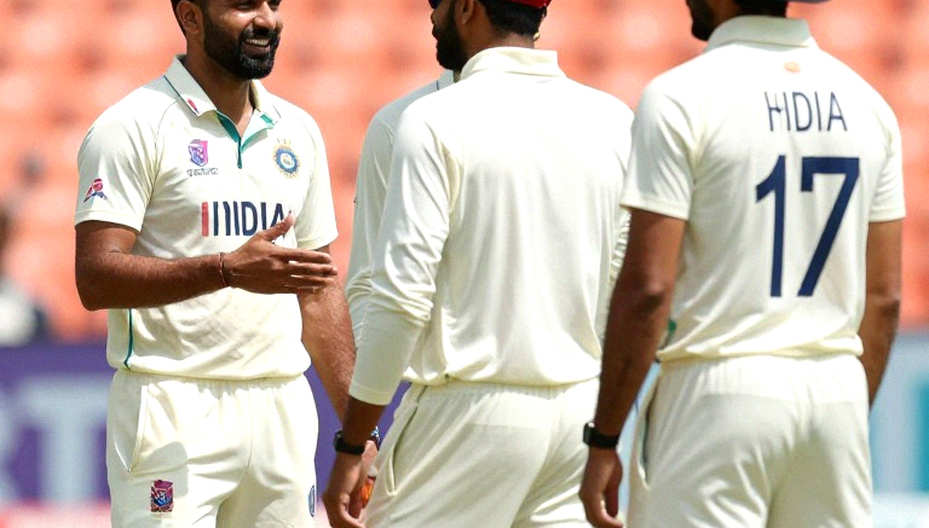
The first row carries the weight. West Indies' last three wickets went down for 4, 0 and 0 — a collapse, not an erosion. But remember that in the same innings Tagenarine Chanderpaul made 56 off 184 balls and shared a 65-run stand with Justin Greaves. West Indies' top order survived in Mirpur; two of the three biggest individual scores in the match belong to Caribbean batters.
Break Chanderpaul's innings into numbers. Fifty-six runs, 184 balls, six fours and one six means roughly 53.6 per cent of his runs came in boundaries, at a strike rate near 30. On a turning pitch where par sits around 250, that is a classic opener's occupation innings — and it is also tempo debt. How many balls he gave his partners while facing 184 is not in the data, and that is the hidden question. If one end crawled, pressure built at the other; and when Greaves (46 off 103, only two fours, around 17 per cent of runs in boundaries) fell, the rest opened up to spin. Greaves was out LBW to off-spin, having earlier been dropped by Mominul Haque. So the 27-run gap was built less on sustained bowling superiority than on discrete lapses.
Now Bangladesh's bowling. Naeem Hasan's four wickets are the match's most quoted figure. In analysis, when wickets fell matters more than how many. Three of Naeem's four were lower-order (Joseph 4, Warrican 0, Seales 0) — he closed the innings rather than broke it open. The hard wickets, Chanderpaul and Greaves, went to Shariful, Miraz and Taijul. Miraz 2, Taijul 2, Hasan Mahmud 1, Shariful 1. That distribution describes a system, not a one-man spell, and spin depth is Bangladesh's single biggest edge here.
Naeem Hasan's durable number is not in this scorecard but in his career arc: he became the fastest Bangladesh bowler to 50 Test wickets. That is a career-shape signal, an early-peaking finger spinner, not a one-match signal. But his away average is absent from the report, so "Bangladesh's frontline spinner" remains an incomplete label. I ask three things before any tactical claim — a field map, a matchup table, and at least three coded clips. Naeem has the map and the table; the away clips are missing. Until they arrive, I will not hand over the label.

On Bangladesh's second innings: Sadman Islam, who made a century in the first, fell for 13. Tanzid Hasan Tamim went 7 and 0. Towhid Hridoy made 42 then 0. That is not one bad day for two batters; it is a pattern — the top order failed to hold on this pitch twice. Tanzid's second-innings mode is the most technical concern: caught at gully attempting a flick to a full-length ball on leg stump. A closed-face leg-side flick to a full ball with a gully in place is a low-percentage stroke, a technical flag rather than a form flag. Hridoy's dismissal sends a blunter message: a batter on 42 playing a big shot to mid-on — a pressure shot, a decision error. When the same team posts a century and then 34/4 inside 11 overs, the problem is depth, not mood.
One more angle on pitch and law that Mirpur coverage tends to skip. When rain or bad light stops a Test, there is no Duckworth-Lewis-Stern target revision. The only currency is overs and time. On Day 3, rain pulled tea forward and bad light later ended play. On paper the rule is neutral; in effect it is not, because Bangladesh must bowl West Indies out twice and every lost over comes out of their bowling budget. If Days 4 and 5 repeat the pattern, the match slides toward a draw — a result produced by weather, not cricket.
Contrarian: The 106 illusion and the undervaluing of West Indies
Here is what the scoreboard avoids saying. Bangladesh are not "strong" in this match; they are "slightly better placed". With four wickets in hand and a realistic target band of 145 to 180 (the conventional estimate of 40 to 70 added by the last four), that band is competitive on a Day-4/5 Mirpur surface against three spinners — not safe. West Indies need one substantial partnership.
And media framing is doing West Indies a disservice. Reading "106 ahead", a fan assumes the Caribbean side is on the brink. In fact the first-innings gap was only 27, and two of the match's three biggest scores were West Indies'. Before calling a team "collapsed", examine the structure of its innings — falling from 134/4 and slipping to 10/2 in the first over are not the same "collapse".
The second counter-intuitive layer is the Naeem hype. Fastest to 50 Test wickets is real, but built on a home-spin diet. Three media phrases — "record-breaker", "new frontline spinner", "spin sensation" — are not yet validated by away data. One innings of four wickets, three of them tailenders, does not make a No. 1 spinner. That label waits for the next away series.
Takeaway: The lead that matters is the last one
Three things will decide where this match goes. First, how much Bangladesh's last four wickets add — a target under 150 makes West Indies favourites, over 180 makes Bangladesh strong favourites. Second, the Day-4/5 weather — another rain or light stoppage raises the draw probability directly, because in Tests time is the real currency. Third, the effect of Mominul Haque's injury; struck on the head while fielding, he was replaced by Jaker Ali as concussion substitute, an added selection headache for a top order already under strain. The real Mirpur question is not 106; it is how many overs Bangladesh's third spinner can carry in the fourth innings. I will wait for that answer — and this time I will have the tape running in advance.